

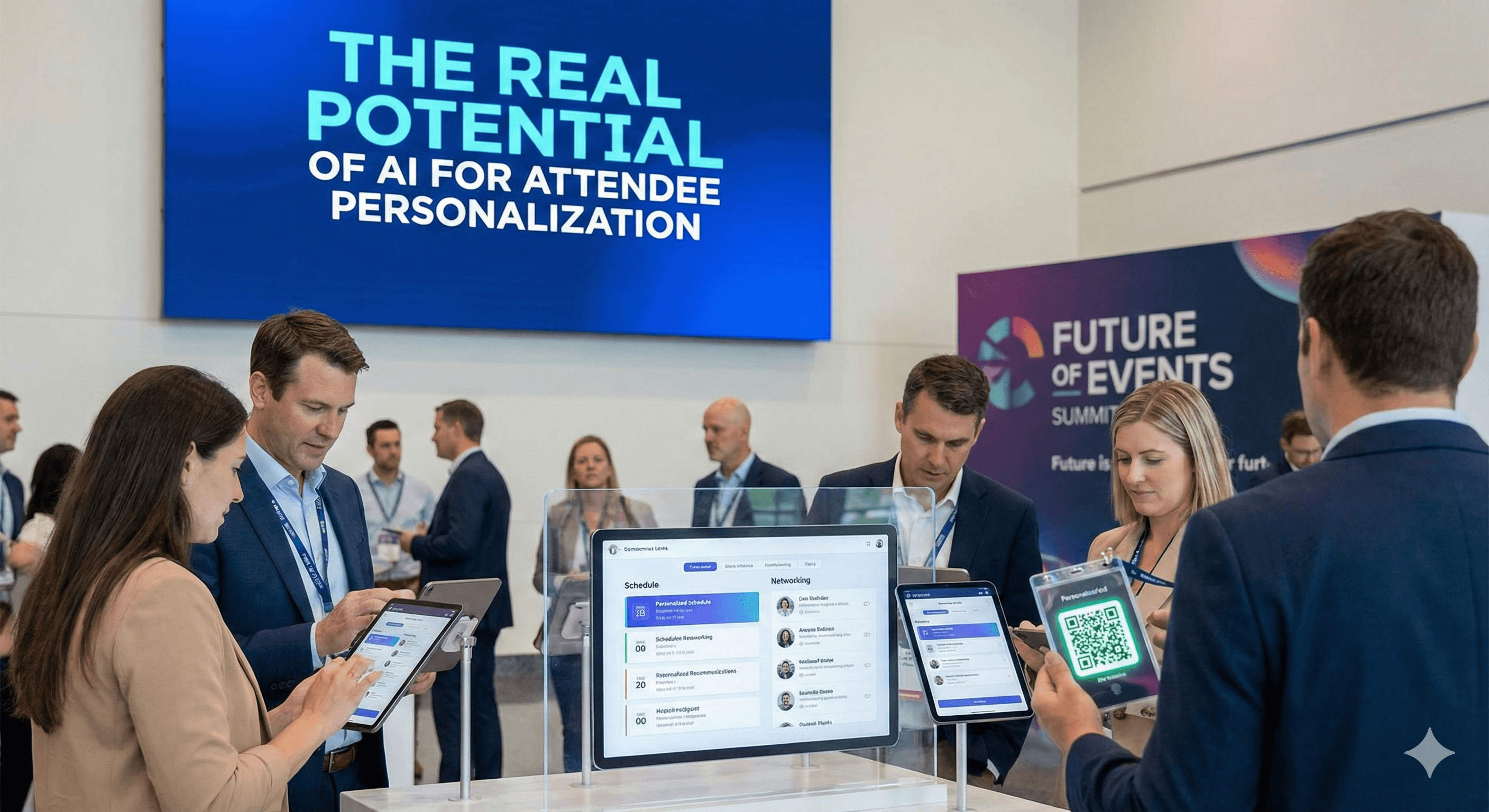
Events generate rich first-party data—what people register for, where they go, who they meet, what they click, what they watch. Used well, that data can power meaningful personalization that boosts engagement, strengthens brand loyalty, and makes your meetings feel like they were designed "just for me."
This blog will walk through:
- What attendee personalization is (and what can actually be personalized)
- The benefits of personalization for corporate events
- How to use common AI tools to deliver personalization
- Where an AI expert can add extra value
1. What Is Attendee Personalization?
Event or attendee personalization means tailoring an attendee's experience—before, during, and after the meeting—to their needs and preferences.
It goes far beyond "Dear [FIRST NAME]." Done well, it's about:
Right content, right connections, right moment—for the right person.
Personalization can touch almost every part of the attendee journey.
Pre-Event: Set the Stage
What can be personalized:
- Invitations & messaging — Different value propositions for executives, people managers, sales, technical teams, partners, etc.
- Registration forms & paths — Customized paths for VIPs, exhibitors, speakers, sponsors, staff, or internal vs. external audiences. Different questions, pricing, and session options by audience type.
- Pre-event content & recommendations — "Based on your interests, here are three sessions you might like." Personalized briefings or "What to expect" guides.
- Early matchmaking — Pre-event suggestions of people to meet via the app, so attendees can plan networking ahead of time.
Onsite: Guide and Support in Real Time
What can be personalized:
- Agendas & session recommendations — Curated agendas based on role, interests, past behavior, and engagement.
- Push notifications & alerts — Personalized reminders about relevant sessions, room changes, or networking opportunities.
- Smart networking — AI-powered matchmaking based on industry, role, region, or shared goals.
- Logistics & accessibility — Dietary-specific meal info, tailored wayfinding, or accessibility guidance for those who requested support.
Post-Event: Extend the Experience
What can be personalized:
- Follow-up emails & content — Key takeaways, recordings, and resources tied to sessions they attended (and those they missed but might value).
- On-demand content recommendations — Suggested recordings or articles based on topics they showed interest in.
- Surveys & feedback — Personalized surveys tied to the sessions, tracks, or networking they engaged with.
At its core, personalization uses relevant attendee data to craft experiences that make people feel seen, valued, and understood—not just processed.
2. Why Personalization Matters for Corporate Events
Why invest time and effort here, especially when your team is already stretched?
1. It Drives Engagement
When attendees receive content, sessions, and connections that clearly relate to their world, engagement goes up:
- They're more likely to attend sessions, ask questions, respond to polls, and participate in networking.
- They feel like you're "talking directly to them," not sending generic messages to a crowd.
2. It Strengthens Brand Loyalty
A tailored event experience deepens the relationship between your audience and your brand: or between your employees and your company.
- They remember the event as relevant and respectful of their time.
- They're more likely to recommend the event and return in future years or for future internal programs.
- For internal corporate meetings, that translates to better alignment, higher buy-in, and stronger connection to company strategy and culture.
3. It Provides Valuable Data Insights
Effective personalization requires collecting and analyzing attendee data. In return, you get:
- Clear insights into what different segments care about
- Evidence of which formats and topics move the needle
- Data to refine your overall marketing and enablement strategy, not just your events
3. Data: The Foundation of Personalization
You can't personalize effectively without good data. But you also don't need all the data—just the right data.
Know What You're Collecting and Why
If you don't know why you're asking a question, it's unlikely you'll ever use the answer.
Start by deciding:
- What do we want to personalize?
- What do we need to know to do that well?
Then design your data collection around those goals.
Pro tip: Be transparent. Clearly tell attendees what you're collecting, where it will be stored, who will see it, and how it will be used to improve their experience. That builds trust.
Useful Sources of Attendee Data
- Registration forms — Interests, preferred topics, product interests, role, region, goals for attending
- Past event data — Which sessions, speakers, or booths drew high engagement. Who returned, and what they attended last time
- Existing CRM / HR / marketing data — Industry, company size, seniority, account status, internal function or business unit
- Behavioral data during the event — Session attendance (via scans/RFID), bookmarking in the app, dwell time in certain areas
- Feedback data — Formal surveys + informal signals (chat messages, Q&A participation, social media activity)
Behavioral data often tells a more reliable story than surveys alone. If someone attends multiple sessions on a topic, that behavior signals engagement—even if their survey answer is lukewarm.
4. How to Use AI for Event Personalization (With Tools You Already Know)
You don't need a custom AI lab to get started. Most corporate meeting professionals can begin with:
- Their existing event tech platform
- Simple large language models (LLMs) like ChatGPT, Copilot, Gemini
- Built-in AI features (chatbots, recommendation engines, analytics)
Here's how to deploy them step by step.
A. Use LLMs to Create Personas and Tailored Content
1. Create attendee segments from your data
Export a (de-identified) sample of registration data and ask an AI tool:
"Group these attendees into 3–5 meaningful segments based on role, goals, and interests. Describe each segment's key needs at this event."
You'll get personas like:
- "Senior leaders driving transformation"
- "New managers looking for confidence and tools"
- "Technical specialists seeking deep dives"
2. Generate tailored messaging for each persona
Use AI to draft:
- Invitation emails for each key audience
- "Your recommended sessions" pre-event emails
- Different versions of app copy or session descriptions (executive summary vs. detailed breakdown)
You still edit—but the first draft is done for you in seconds.
B. Use Chatbots and Virtual Assistants
Embed AI-powered chatbots in your event app or website to:
- Answer FAQs: "Where is Room B?" "Is lunch included?"
- Provide personalized guidance: "What's next on my agenda?"
- Recommend sessions: "I'm a first-time people manager—what should I attend this afternoon?"
This gives every attendee a personal concierge without scaling onsite staff.
C. Use AI for Session & Content Recommendations
Machine learning models built into many event platforms can:
- Suggest sessions, speakers, exhibitors, or posters based on attendee interests and past behavior
- Adjust recommendations in real time based on engagement (what they've bookmarked or attended)
Post-event, the same logic can deliver on-demand recommendations: "Because you attended X, you might like these recordings…"
D. Use AI for Smart Networking
AI-powered matchmaking tools can:
- Connect attendees based on shared interests, industry, job role, or goals
- Suggest small-group meetups, mentoring matches, or cross-functional partner meetings
- Help structure networking time so it feels intentional, not random
This is especially valuable for sales kickoffs, leadership meetings, or customer advisory boards where the right connections matter.
E. Use AI for Real-Time Data Analysis
Events generate a lot of data—far too much to interpret manually in real time.
AI can:
- Monitor engagement and sentiment during the event
- Flag under-attended sessions or low-engagement time blocks
- Highlight hot topics that might deserve extra coverage or a follow-up session
You can then make live adjustments (room changes, content tweaks, schedule shifts) instead of waiting until the post-mortem to realize what you could have changed.
5. Measuring the Impact of Your Personalization
To prove value—and improve over time—you need to measure whether personalization is actually working.
Key approaches:
1. Attendee Surveys and Feedback
- Pre-event: expectations and goals by segment
- Post-event: "Did you find it easy to discover sessions relevant to you?" "Were networking recommendations relevant and useful?"
Use a mix of rating scales and open text to capture both numbers and nuance.
2. Event App & Website Analytics
Track:
- Use of personalized schedules or recommendations
- Click-through rates on "recommended for you" content
- Drop-off points where attendees stop engaging
This shows where your personalization is helping and where it may be confusing or irrelevant.
3. RFID / Badge Scans and Foot Traffic
RFID and scanning can reveal:
- Which sessions attendees actually attended
- Which booths or zones drew traffic
- Dwell time in different areas (e.g., demo zones, lounges, expo hall)
Overlay this with your recommendations (and even heatmaps of movement) to see if personalization influenced behavior.
4. AI-Powered Sentiment Analysis
Use AI tools to analyze:
- Chat messages in the app
- Social media mentions
- Open-ended survey comments
Sentiment (positive / neutral / negative) helps you understand whether personalized elements felt helpful, creepy, or invisible.
5. Engagement with Personalized Content
Measure:
- Open and click-through rates for personalized emails and notifications
- Usage of recommended sessions, networking matches, and on-demand links
- Re-visits to recommended content after the event
These are strong indicators of whether your personalization is resonating and delivering lasting value.
6. What an AI Expert Can Add
Much of this is achievable by a savvy events team with good tech partners. But an AI expert—internal or external—can help you move faster and avoid common pitfalls.
Strategic Value an AI Expert Can Bring
- Strategy & roadmap — Translate event goals into concrete AI use cases and a phased plan.
- Data architecture & integration — Connect event platforms to CRM, HRIS, LMS, and marketing tools. Ensure clean, usable data and clear governance.
- Custom personalization logic — Design models and rules that reflect your business reality (e.g., account priority, internal job families, enablement goals).
- Automation & workflows — Build automations so personalization flows from registration → app → onsite → follow-up without manual effort each time.
- Advanced analytics and ROI — Define metrics, dashboards, and experiments that link personalization to engagement, adoption, pipeline, or other KPIs.
- Ethics, privacy, and change management — Set guardrails for what you will and won't infer or automate, ensuring AI enhances the human-centered design of your events rather than undermining trust.
Final Thoughts
To captivate attendees, build brand loyalty, and prove event ROI, tailored experiences can't be an afterthought anymore—they have to be part of your core strategy.
The good news is that AI and modern event tech make personalization scalable. When you do, your meetings and events will feel less like one-size-fits-all programs and more like events that are personal, meaningful, and unforgettable—and that clearly support your organization's goals.